













 Which American 2000s TV Series Are You?
 The Perpetual Student Syndrome: When Self-Development Becomes a New Form of Procrastination
 Test: Who Were You in a Past Life?
 Your Mythological Totem: Take the Test and Find Out Which Ancient Creature Protects You?
 Adulthood Test: Find Out How Old You Really Are
 Empathy Check. How Well Developed Is Your Emotional Intelligence?

 English
 Русский
 Deutsch
 Español
Mental Traps That Are Easiest to Fall Into During Winter
Winter is a special time of year when the usual rhythm of life naturally slows down. The daylight hours become shorter, social interactions become rarer, and the surrounding space fills with more silence and pauses.

Under these circumstances, it becomes harder for a person to stay in tone: attention begins to wander more quickly, emotions react more sharply, and the inner monologue intensifies. All of this makes us more susceptible to hidden mental traps - those automatic patterns of thinking that drain energy but do not bring results.
The peculiarity of winter is that it amplifies background states: small doubts turn into excessive overthinking, slight anxiety becomes a desire to control everything, and even mild fatigue turns into procrastination. It's not that these traps are "born" in winter, but this season makes them show themselves most clearly.
The reason is simple: the brain shifts into a more economical mode, trying to conserve warmth and energy - and its thinking becomes less flexible, less optimistic, and less quick. Below are the key winter mental traps, reinterpreted and explained with seasonal psychological specifics in mind.
1. The Trap of Winter Perseverance: the habit of continuing what has long lost meaning
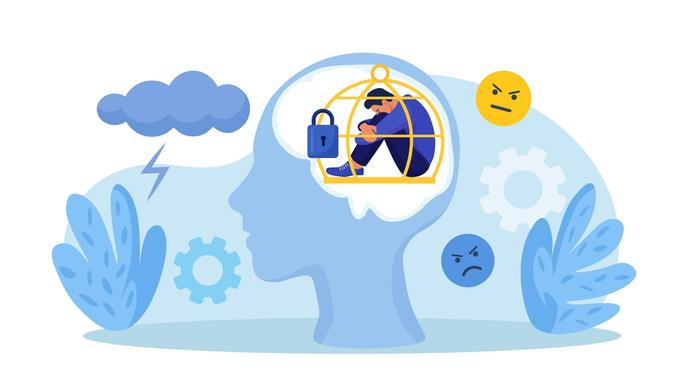
When there are few external stimuli and life becomes more measured, the brain finds it especially hard to switch between tasks. Therefore in winter we more often "hold on to" projects, relationships, tasks, or domestic processes simply because they have already been started. It seems to us that since we have invested effort, it would be wrong to quit. The paradox is that it is precisely in winter that such decisions become less rational: we confuse "I don't want to spend energy switching to something else" with "this is truly important."
And let's not forget the well-known tradition of "leaving everything bad and difficult in the old year." It's as if at the genetic level we already have a built-in desire to finish everything before the New Year that we started during the previous twelve months - even if for eleven of those months we procrastinated and postponed everything "until later."
Because of this, a person may continue reading a book they no longer enjoy, finish an old project that nobody needs anymore, or even keep up a conversation they've long wanted to end. As a result, nerves, time, and attention are wasted - and a sense of satisfaction does not appear anyway. And it won't appear, even if you actually manage to complete the pending task before the New Year, unfortunately.
How to fix it: ask yourself three honest questions: "What will change if I stop this right now?", "Is guilt the thing that's holding me here?", "Would I advise someone close to me to continue?" Winter is the best time to learn not only to finish what you start, but also to gently let go of what is no longer needed.
2. The Trap of Amplification: excessive complicating against the backdrop of winter slowdown
With the arrival of cold weather, a person's cognitive speed naturally declines: it takes us longer to "warm up," we formulate thoughts more slowly, we doubt more often. In other words, we slip into a mild "hibernation mode," much like all living things around us. In this state, the brain may attempt to compensate for uncertainty by complicating things. We begin to recheck every little thing, over-polish the text, pay attention to format instead of essence, and hold a task in our mind longer than it deserves.
For example, an email that you would write in five minutes in summer turns into a twenty-minute ritual in winter. A report takes half an hour just to format, a spreadsheet gets redone ten times, and any presentation is accompanied by endless mental rehearsals.
In addition, in winter we tend to overestimate the consequences of mistakes: it seems that any minor flaw will be "more noticeable," because overall activity is slowed down and every detail feels like it carries more weight. As a result, a person begins to spend energy not on moving forward, but on endless perfecting - even though the real usefulness of this effort is minimal.
How to fix it: use the winter principle of "good enough quality." Set a timer: 20 minutes for completing, 10 for checking. Everything beyond that is excess energy expenditure - and in winter you already need more energy just to operate at your normal pace. It also helps to narrow the task's parameters in advance: instead of "write the perfect text," set the goal of "convey the meaning as simply as possible." This allows you to regain control quickly and avoid sinking into unnecessary layers of complexity.
3. The Trap of Winter Waiting: when the day becomes a gap between events
In cold weather, activity decreases, and the brain begins to live by the "future point" - a meeting, a call, a message, an important task. All the time between these events quietly becomes empty space. We're not doing anything wrong; we're simply in a state of anticipation that consumes attention. For example, if an important meeting is scheduled for the evening, the whole day may pass in anxious waiting. If you expect someone's reply, you automatically get distracted every ten minutes.
Series, social media, tea - all become "background time-fillers" until the necessary moment arrives. And the colder it gets outside, the faster the body slips into this "waiting mode," because the brain ranks energy conservation as a higher priority than initiative. As a result, a person feels as though the day "did not happen," even though technically it was filled with small tasks.
How to fix it: turn waiting into action. Do one small but concrete step: open a document, reply to one email, sort through one note. This brings back a sense of control and makes the day meaningful. You can also create in advance a list of "micro-tasks" - 3-5 minute actions - so that between major events, the brain has alternatives besides procrastination and anxious monitoring. This reduces the internal emptiness and makes winter far more productive.
4. The Trap of Anticipation: the desire to "do everything in advance," dictated by winter anxiety
In winter, anxiety grows faster - hormonal cycles, lack of sunlight, and decreased activity all play a role. Therefore the need to "secure the future" increases. People begin doing work ahead of time, taking on extra tasks, clarifying details that are not needed yet, and spending hours preparing for events that might not occur at all.
The irony is that winter tasks tend to change more often: colleagues go on vacation, delays occur, unexpected rescheduling happens because of weather, illnesses (everyone gets sick in winter), and holidays. Something you've completed in advance can lose relevance at any moment.
Additionally, anticipation creates a false sense of productivity - it feels like you're being proactive, though in reality you're sinking into unnecessary organizational layers. When anxiety drops, it becomes clear that 30-40% of that effort was unnecessary.
How to fix it: before starting something "in advance," ask yourself: "Does this really need to be done right now?", "Is there a risk everything will change - and what kind of risk?", "Am I doing this to reduce anxiety rather than out of necessity?" Sometimes it is wiser to wait, and fight anxiety through other methods, not through the illusion of control. You can even define personal criteria: "I do something in advance only if I know for sure it won't change." This will help conserve energy and avoid wasted work.
5. The Trap of Winter Resistance: the urge to postpone important things "until better times"

Sometimes the situation is the complete opposite of the previous one. In the cold season, the level of physical energy naturally falls. You want to sleep more, switch on more slowly, seek warmth and comfort. Therefore any important task feels too big to start "right now." We postpone - and then feel guilty for not accomplishing anything again.
But this is not laziness. This is that same physiological attempt by the body to save warmth and resources. When the brain senses an energy deficit, it automatically blocks tasks requiring concentration and pushes a person to stall. If you give in fully, winter becomes a season of "delayed life," where a person is constantly waiting for an imaginary moment when strength will appear - even though strength appears only after action begins.
A person may genuinely want to start the work, but feels the need for "five more minutes to warm up." These five minutes turn into half an hour, then into an hour, then into the night before the deadline. The point is that in winter the brain takes longer to get up to working speed. Therefore it feels as if waiting will help the concentration "arrive by itself" - but that is not true. It arrives only after beginning the task.
Delaying creates the illusion of self-care: as if you are "preserving strength." But in reality you lose your internal pace - and with it, your motivation.
How to fix it: distribute your workload according to the "seasons of the day." The most important tasks - in the morning, medium tasks - during the day, light tasks - in the evening. And do not overload one single day with too many obligations: in winter the brain critically needs free time and mental space to maneuver.
In addition, try reducing task size: break a large goal into "winter chunks" - steps of 10-15 minutes. This decreases resistance and makes it easier to begin.
Lectera’s Online Courses by topic
How to generally deal with winter mental traps
Working with winter traps begins not with self-control but with observation. You need to learn to notice what state your attention, energy, and emotional background are in. In winter even small fluctuations in these areas become especially telling. Try recording your condition in a small diary - even short notes will help you see which situations most often activate the "winter mode" of thinking, and where you are spending more strength than necessary.
The second important strategy is processing negative experiences. In winter emotional load stays longer, and any small stresses tend to resurface again and again. If you don't let yourself digest emotions, they become "fuel" for traps: they reinforce fixation, delaying, anxious anticipation. Therefore it is helpful to talk about your feelings, keep emotional notes, and allow yourself to rest when overload hits. This is not weakness - it is prevention of large internal "winter blockages."
The third foundation is strengthening self-worth. It is lowered self-value that makes a person vulnerable to mental traps: they start finishing unnecessary tasks, apologizing excessively, trying to please everyone, fearing to do something imperfectly. In winter these processes intensify, because self-esteem reacts more strongly to fatigue and lack of sunlight. Work on internal support: remind yourself of your achievements, record successes, maintain emotional boundaries.
And finally, it is important to adjust your behavior gently, without trying to "cut out" all traps at once. They are part of natural psychological economy. But you can reduce their power by slightly redirecting yourself: adding small actions instead of waiting, lowering perfectionism instead of amplifying, halting premature activity instead of anticipating events. When you act carefully and gradually, winter traps stop being traps - and turn into signals about where you need to add warmth, clarity, or attention.
Share this with your friends via:
Latest News

Fall 2026 promises to be an eventful season for education worldwide.

Tickets for WE Convention 2026 are now available - with 25% off for EARLY BIRDS!

The private school Alpha School, which has opened campuses from New York to California, uses AI bots to teach children academic subjects for just two hours a day. The school has no traditional teachers, no homework, and tuition reaches $65,000 per year.

UK Prime Minister Keir Starmer has announced a major public-private partnership in the field of artificial intelligence. Google, Microsoft, Amazon and NVIDIA, together with the government, are launching an AI skills training programme for 7.5 million British workers.

International educational programmes provider Study Group has announced a change of ownership. The company has been acquired by Arete Education – an investment structure in the higher education sector created by Global University Systems (GUS) and US private investment firm Brightstar Capital Partners.
