


















 English


Project manager

Who Is a Project Manager?
Project Manager - a specialist responsible for the implementation of a wide variety of team projects. This involves organizing the work of other specialists and managing processes. In other words, a Project manager is a link between employees, such as developers and marketers, designers, and analysts, as well as between the project team and the client.
Primarily, project managers handle management tasks-from assembling the team to budgeting, identifying and resolving issues, analyzing potential risks, and maintaining communication within the team and with stakeholders.
It's essential to recognize that a project requires a specific timeframe and is not a continuous process. A project always has a start and an end, whereas various processes can run continuously for as long as the company exists.
For example, developing and launching a new website, holding an annual conference, creating a mobile app, moving an office to a new building, or developing a new staff training system-these are all projects, which. And they have a specific budget, deadline , and team (led by the project manager). A process, by contrast, is an ongoing, repeatable activity that keeps the company running smoothly-for instance, bookkeeping, processing customer orders, updating the website, and so on.
Projects exist across many industries-IT, manufacturing, healthcare, education, and construction. Therefore, project management specialists are needed at various levels, from small and medium-sized businesses to large corporations. Some project managers work freelance and successfully manage several projects at once.
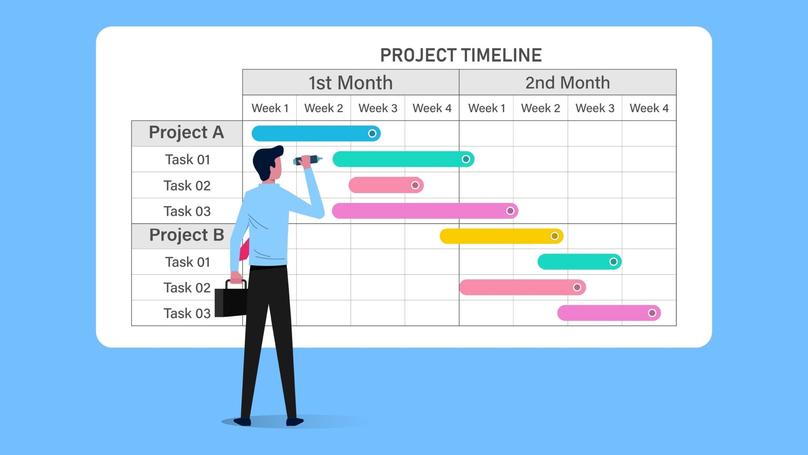
Interestingly, the project management profession originated in the middle of the last century, when, after World War II, construction of major technical, defense, and infrastructure projects (for example, in nuclear energy and space exploration) began. This created an acute need for systematic management and led to the emergence of early tools for that purpose (for instance, the Gantt chart, which visualizes the timeframes required to complete tasks).
As early as 1969, the Project Management Institute (PMI) was founded in the United States-the first international organization for project managers. And in 1996, PMI released the first version of the PMBOK (Project Management Body of Knowledge)-the profession's standard. By the 2000s, flexible methodologies (Agile, Scrum) had become especially popular in IT and startups. With the spread of information technology and the development of software, the need for project managers has become critical. Modern IT projects are often highly complex, multifaceted, and fast-moving, which is why project managers are most in demand in this field.
What Does a Project Manager Do?
Key responsibilities include:
-
Project planning
This involves meeting with the client to agree on objectives and clarify requirements, expectations, potential budget, and timeline. The manager then determines how the project will be delivered-by what means, with which tools, and within what timeframes-and estimates costs under three scenarios: pessimistic, neutral, and optimistic.
-
Team management
This involves distributing responsibilities-key tasks-to employees, notifying them of deadlines, and, later, running daily or weekly meetings, and helping resolve disputed issues.
-
Communication
It is important to maintain communication between all project participants - and this is not only the team (programmers, authors, SMM specialists, Data Scientists), but also customers, investors, and other stakeholders (such as vendors). The communication process also covers discussing work matters in writing and in person (hence, the project manager must be aware of all project details, spanning development, design, and content), moderating shared chats, keeping reports, providing the team with the necessary information, and aligning on requirements and changes. Gathering feedback from clients and team members is also important to improve the process.
-
Deadlines and task control
This involves tracking task execution against the plan and updating task statuses in trackers. For example, you can use Trello, Asana, Jira, ClickUp, or Todoist-these tools offer various functions and approaches to task management, from simple Kanban boards to complex project management systems with diagrams and time tracking, and preventing missed deadlines.
-
Budget management
This means cost control and coordination with management in the event that additional resources-time, finances-are needed.
Analysis of potential risks and development of strategies to minimize them.
-
Reporting
Preparing regular updates on project progress and task status, and informing stakeholders about decisions made and any arising issues.
-
Verification
Ensuring that the deliverables align with the client's agreement. The project manager then organizes a test launch of the product, verifying that everything functions correctly and that there are no errors or gaps.
-
Project closure
Summarizing results, conducting plan vs. actual analysis, reviewing mistakes, and handing the project over to the client.
In practice, throughout the day, a project manager stays available, holds calls and negotiations (e.g., with new vendors, clients, and creators of the end product), checks messages in email and messengers, runs the daily stand-up, and, based on team feedback, addresses emerging issues, while monitoring (and updating) the plan and other documentation.
Essential Project Management Skills
A project manager's work is not just about tracking deadlines and tasks. It serves as a connector between the team, the client, and the end result. Therefore, a PM must have both hard skills and soft skills, which are especially important when implementing projects and managing large teams.
Hard skills - skills that can be measured and are easy to teach. So, project managers should possess the following:
-
Knowledge of project management methodology (Waterfall, Agile, Scrum, Kanban) and the ability to implement them
Different projects, depending on the industry, goals, and timeframe, require different approaches. Launching an IT startup won't follow the same model as building a new shopping center or opening a franchise restaurant. A project manager must be able to adapt a given approach to the specific context.
-
Proficiency with project tools
This means knowing and using specialized software to organize tasks, control timelines, and manage resources. For example, Notion, MS Project, and other applications. Without them, a project risks slipping into chaos, the team will lose track of tasks, and deadlines will be at risk.
-
Industry-specific knowledge
Typically, project managers run projects within one or adjacent industries because understanding industry specifics is essential. For example, if you are a PM in IT, you should understand all stages of software development, know how the frontend and backend work, the principles of working with APIs, and the standard terminology.
-
Analytical skills
It is important to be able to calculate project cost and forecast overruns, analyze metrics, and always keep an eye on the numbers to avoid losing control.
Soft skills are personal qualities that determine how a PM interacts with people and copes with stress and uncertainty at different stages of project implementation.
- Communication skills
A project manager is responsible for everyone: the client, the development team, the marketers, and the testers. And miscommunication is one of the main reasons for project failure.
-
Empathy and emotional intelligence
The ability to sense the team's state and understand motivation and fatigue is especially important because, without this, effective people management is impossible.
-
Stress resistance
You must always be ready for things to go off plan at any moment. A PM should stay calm, make quick decisions, and avoid panic. This also matters because the PM sets the emotional tone for the whole team: if the PM panics, others will follow. A professional PM should be a guarantor of calm and confidence in the project's success.
-
Organization and systems thinking
This is the ability to keep multiple tasks in mind, remember details, and think structurally. Every project involves numerous variables, and if the PM becomes confused and allows chaos to arise, the project will fall apart.
- Negotiation and conflict resolution skills
Conflicts and disputes are an inevitable part of any teamwork. Therefore, it's crucial for a PM to be able to persuade a client, negotiate with the team, and relieve tension. This requires using different strategies and techniques (for example, collaboration implies joint problem-solving; compromise-mutual concessions; avoidance is acceptable only if the conflict is minor and can be resolved without a third party). The PM should remain impartial and attentive, help surface interests and concerns, and steer disputes toward a constructive solution.
-
Resourcefulness
This will help you cope with uncertainty and find a way out of the most difficult situation.
-
Flexibility and adaptability
Changing requirements, customer feedback, unexpected problems, and new opportunities require managers to quickly adapt and adjust their strategy.
Difference Between a Project Manager and a Product Manager

Many assume that the roles of project manager and product manager are interchangeable. They are not. To understand the difference, it's enough to look at the two words-"product" and "project." A product is a specific good or service, i.e., a defined, concrete thing whose sale is the business itself-the thing that keeps it afloat. A project, by contrast, is a time-bound process.
In other words, a product is the result of multiple projects. Accordingly, a product manager is responsible for the product's promotion and development strategy, determining who it's intended for and what customer problems it solves. They focus on long-term success, product demand, and user satisfaction.
A project manager, on the other hand, is responsible for delivering specific projects needed to create and develop the product (for example, launching a mobile app, developing a new website, creating a marketing campaign on social media). As a rule, the product manager sets the goals and tasks, and the project manager ensures they are completed within the defined timeline, budget, and other constraints.
The Difference Between a Project Manager and a Scrum Master
A project manager and a Scrum master are two distinct roles. Although both are involved in team management, the project manager is responsible for overseeing the entire project-including planning, budget, deadlines, logistics, and the final outcome. The Scrum Master, by contrast, focuses solely on the team's effectiveness: they coach the team and help it work within the Scrum framework. In practice, they do not manage the team; instead, they guide it, train it, refine its processes, and improve productivity.
What Does a Project Manager Do in Different Industries?
The project manager position exists in almost every field, but the actual role, tools, and expectations for the specialist differ greatly.
For example, a PM in IT and software development must be ready for frequent changes in requirements, be able to work with Agile/Scrum, break work into sprints, and track their completion. A PM in IT should also know the SDLC (software development life cycle) and CI/CD.
In construction and engineering, the specifics are different. Changes occur less often here, but there are strict regulations, a large volume of documents, and a high cost of errors. In this case, the PM will be occupied more with drafting detailed plans, schedules, and estimates; coordinating contractors and suppliers; controlling compliance with building codes and timelines; and working with technical documentation and drawings. Therefore, they must be familiar with construction standards, project and estimate documentation, and services such as AutoCAD, MS Project, and Primavera. In other words, the PM's role in construction is to control the building process.
In marketing and communications, the project manager is responsible for launching advertising campaigns, so it is important to be prepared for a high degree of uncertainty, subjective evaluations of results, and rapid shifts in priorities. In this industry, the PM usually assembles the creative team, draws up promotion strategies, monitors campaign launch deadlines and coordinates revisions with the client, and works with vendors (for example, production houses or digital agencies). For this, one needs to know marketing tools (CRM, analytics, media planning) and be able to translate creative ideas into the language of business.
There are also PMs in non-profit organizations. The key features of their work include operating with a limited budget, focusing on positive social impact, and aligning with a large number of stakeholders. A PM needs to know the basics of grant management and compliance, have skills in reporting and financial planning, show empathy, and be able to work under resource constraints.
How to Become a Project Manager
You can enter the profession in several ways-for example, by taking an online course. On average, such programs last about six months to a year. You'll learn how to prepare documentation, conduct negotiations and build teams, and work with stakeholders. Programs include both theory and practice. Many participants come from adjacent fields and already possess many of the skills; marketers, department coordinators, and executive assistants often move into project management. It's an effective tool for career advancement.
There are several main certifications for project managers, the most famous of which are PMP (Project Management Professional) from PMI and certifications from IPMA(International Project Management Association). PRINCE2, AgilePM, and others are also popular, depending on the project management methodology.
So, retraining as a project manager is in many ways a natural career path and a solution that specialists from a wide range of fields come to. Project management can be learned from scratch by enrolling in a university and obtaining a specialized education. Many employers consider a relevant degree a significant advantage and prefer candidates who have one. Preference will be given to applicants with a relevant diploma.
However, if you have relevant work experience and all the necessary skills, the lack of a degree isn't always a hindrance. For example, you can study project management on your own by listening to free lectures, watching interviews with speakers who share your experience, and reading articles and books. Beginners can read:
-
"Deadline: A Novel About Project Management" by American engineer Tom DeMarco. The book introduces you to the basics of project management through real-life stories and practice. It covers all stages of the project life cycle, from planning to delivery, and pays special attention to the planning process and risk management.
-
"The PMBOK Guide"-This is the bible of project management, created by the Project Management Institute. It is a comprehensive guide to project management that includes standards, processes, and best practices.
-
"Peopleware. Successful Projects and Teams"-The book, co-authored by Tom DeMarco and Timothy Lister, focuses on the human factor in project management. It pays special attention to teamwork, motivation, maintaining communication, and other soft skills that impact project success.
-
"Scrum: A Revolutionary Project Management"-a book by American programmer Jeff Sutherland, one of the creators of Scrum and a co-author of the Agile Manifesto. It is a guide to the Scrum method, which is widely used in IT projects. The author describes the principles and framework of agile methodology in detail.
Conclusion
The profession of project manager is, above all, about responsibility-the ability to make decisions quickly, handle unexpected problems effectively, and see even the most complex tasks through to completion. If you enjoy bringing order to things, systematizing multi-stage, multi-component processes, communicating with people, and taking ownership, you can become a professional project manager.
If, however, working under pressure, with tight deadlines and uncertainty, is difficult for you and you prefer more freedom of action, then it's better to consider other professions. A project manager must not be afraid to change plans boldly in risky situations or emergencies. In addition, they often have to juggle dozens of tasks: resolving several conflicts at once, negotiating with vendors, and keeping reports.
That's why it's important to continually strengthen your stress tolerance, conflict-management skills, and ability to conduct constructive dialogue. But it's worth it! The project manager profession offers numerous opportunities across various fields and organizations, ranging from IT startups to large commercial corporations, nonprofit charities, and medical or educational centers. It also lets you build universal, in-demand skills that are valued everywhere.