











 Which American 2000s TV Series Are You?
 The Perpetual Student Syndrome: When Self-Development Becomes a New Form of Procrastination
 Test: Who Were You in a Past Life?
 Your Mythological Totem: Take the Test and Find Out Which Ancient Creature Protects You?
 Adulthood Test: Find Out How Old You Really Are
 Empathy Check. How Well Developed Is Your Emotional Intelligence?

 English
 Русский
 Deutsch
 Español
The End of the “Buy” Button: Why Traditional Online Stores May Disappear
The “Buy” button feels like such a natural part of an online store that it is hard to imagine online shopping without it.

But some experts believe that this is exactly where things are heading. In August 2026, Stripe's President of Technology, Will Gaybrick, said that familiar checkout pages could eventually disappear. The reason is fairly simple: if an AI agent makes the purchase on a person's behalf, it does not necessarily need to go through the same process we do today.
What is most interesting is that this is no longer just a prediction. Stripe is developing tools for what is known as agentic commerce. AI is gaining the ability not only to recommend a suitable product to a user, but also to take over part of the purchasing process: find the right offer, check the price and availability, take delivery terms into account, and in some cases carry the order all the way through to payment.
The difference is easy to see with a simple example. Today, a request such as "I need good headphones under 150 euros" ends with a list of recommendations. After that, you still have to open the stores yourself, compare models, check delivery options, and place the order. In an agentic commerce model, the task for AI might sound different: find wireless headphones under 150 euros with good noise cancellation, free returns, and delivery by Wednesday. The user only has to choose from the suitable options or confirm the purchase.
It is this final step that could seriously change the way e-commerce works today.
From Adviser to Buyer
For AI to actually take over the checkout process, simply being able to find suitable products is not enough. It also needs access to the information that shoppers currently check themselves: the current price, whether the item is in stock, delivery times, return conditions, and payment methods.
Suppose you regularly buy the same cat food and no longer want to monitor prices yourself. The agent is given a specific task: order a particular package, choose an offer that does not exceed a set price, and have it delivered by a certain date. If the product becomes more expensive or goes out of stock, the purchase must not be made - the user must be informed first.
It is for scenarios like these that payment companies are now building dedicated infrastructure. For example, they are developing mechanisms that allow an AI agent to carry out a transaction authorized by the user without giving it access to the actual bank card details. The authorization can also be limited to a specific amount, merchant, or other conditions. In other words, the algorithm does not receive unrestricted access to the account: it can act only within the boundaries of a purchase that has been defined in advance.
For online stores, this also means major changes. Their websites now need to be understandable not only to people. AI must be able to determine on its own which products are in stock, how much they cost right now, when they can be delivered, and whether they can be returned. If this information cannot be retrieved or is presented ambiguously, it will be harder for the agent to include that offer in its selection.
And this is where agentic commerce starts to change far more than the payment process itself. For the first time, an online store has another participant it also needs to persuade to choose its product - the algorithm.
So Who Are Stores Selling to Now?
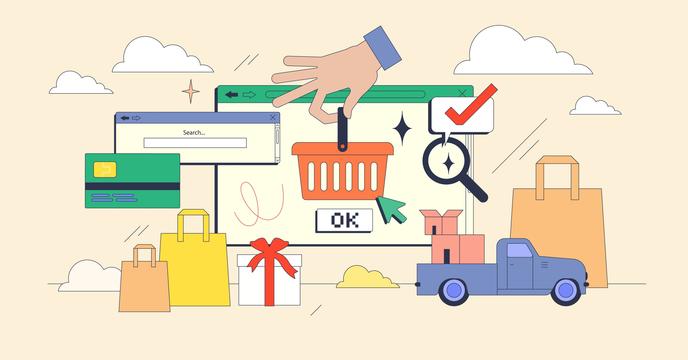
An online store is literally designed to persuade us to buy something. A large photo, an attractive description, a crossed-out old price, customer reviews, a "only three left" message, recommendations for similar products - every element on the page is designed to capture human attention. An AI agent does not have attention in the usual sense at all.
Suppose a user asks it to find a suitcase for under 200 euros, weighing no more than three kilograms, suitable for carry-on luggage, and deliverable by Thursday. A store can call the model "the perfect companion for every journey" as much as it likes, but the algorithm does not care. It needs the weight, dimensions, price, availability, delivery time, and return policy.
That is why agentic commerce creates a new task: the product must be just as understandable to a machine as it is to a person.
Stripe is already encouraging sellers to make product information available to AI agents in a structured format - with up-to-date prices, specifications, and other data required for making a choice.
For businesses, this is a fairly significant shift. Previously, the main competition was for the customer's attention: ranking higher in search results, bringing them to the website, getting them interested in the product page, and persuading them to click "Buy." Now another participant is gradually appearing between the store and the customer - one that can filter out dozens of offers before the user even sees them.
Online Stores Want to Get Into AI - Without Giving Up the Customer
For online stores, the new scenario looks appealing. If people start searching for products through AI assistants, it makes sense for brands to establish a presence there as early as possible. It is another sales channel - much like search engines, marketplaces, or social media once were. But there is one problem. The more work AI takes over, the less the customer interacts with the store itself.
In the past, a brand could bring someone to its website, show them a new collection, invite them to register, award bonus points for a purchase, or recommend something else. But if the user simply tells an assistant, "find the best-value running shoes under 120 euros," that entire journey may be reduced to a handful of options selected by the algorithm. The customer may not even see the websites of the other stores.
And businesses are already concerned about this. In August 2026, payment company Adyen reported that sellers are increasingly thinking about how to preserve direct relationships with customers as AI shopping becomes more widespread. The reason is clear: if a chatbot becomes the main intermediary between a person and a store, it also begins to control the moment when the choice is made.
This leaves businesses with a rather contradictory task: they need to be accessible to AI agents without becoming a faceless product supplier in the eyes of the customer.
For example, if someone has been ordering cosmetics from the same store for years because of its loyalty program and good service, the brand needs the AI to take more than just the price of a particular cream into account. Otherwise, the algorithm may send the customer to a different seller every time simply because that store happens to be a couple of euros cheaper that day.
This is where a new round of competition begins. Stores will have to think not only about how to attract customers, but also about what data will help an algorithm understand their advantages: free delivery, fast returns, a warranty, accumulated loyalty points, a personalized discount, or the option of same-day delivery.
It's Easy to Trust an Algorithm With the Choice. Money Is More Complicated
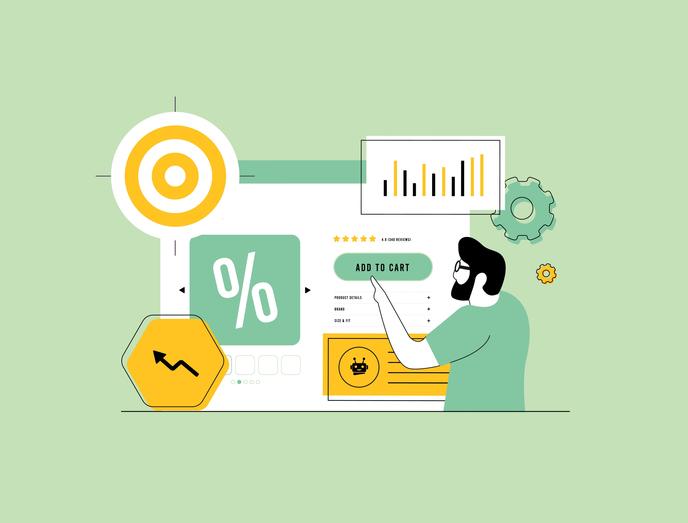
There is another problem as well. Asking AI to recommend five good coffee machines is one thing. Allowing it to spend 500 euros on its own is something else entirely.
And this is where consumer enthusiasm drops noticeably. According to a Checkout.com study published in June 2026, one-third of respondents expect AI to be involved in at least 10% of their purchases within a year. At the same time, 27% said they would not currently trust any organization to manage purchases on their behalf, while almost a quarter are not prepared to give AI the authority to make purchases for them at all.
A European study by Ecommpay shows a similar picture. Most respondents believe that AI shopping assistants will become commonplace in the next few years, but half are still unwilling to share their bank card details with them.
And that is entirely understandable. What happens if the assistant orders the wrong model? Who is responsible if the price changes immediately before payment? What if the algorithm misunderstands the condition "no more than 100 euros" or chooses a store with inconvenient return rules?
That is why the first mass-market agentic commerce scenarios are likely to be fairly cautious. It is easier to trust AI with a one-off order for a familiar low-cost product than with the purchase of a laptop, airline tickets, or expensive furniture.
Payment systems are also trying to set clear boundaries for algorithms. With Stripe, for example, payment authorization for AI can be limited to a specific merchant, amount, and period of validity. The transaction itself can then be monitored in the same way as a conventional payment. So the main barrier to this new form of commerce is not really AI's ability to find the right product. It is getting better and better at that. The much harder task is convincing people that the algorithm can be trusted with the next step.
Lectera’s Online Courses by topic
So Will Online Stores Actually Disappear?
Most likely, no. At least not in the near future. Stores will still need a catalog, a payment system, inventory, delivery, returns, and customer support. What may disappear is something else - the need to make customers go through all of that infrastructure themselves every single time.
Some purchases will remain familiar. If someone is choosing a dress, furniture, or expensive electronics, they will probably still want to look at photos, read reviews, and compare several options themselves. But things may work differently with routine and straightforward purchases. Pet food, household cleaning products, office supplies, or familiar personal care items are well suited to a "find the best option and order it" scenario.
So it is too early for businesses to remove the "Buy" button. But it already makes sense to prepare for a future in which some customers may never reach it at all.
Share this with your friends via:
Latest News

Fall 2026 promises to be an eventful season for education worldwide.

Tickets for WE Convention 2026 are now available - with 25% off for EARLY BIRDS!

The private school Alpha School, which has opened campuses from New York to California, uses AI bots to teach children academic subjects for just two hours a day. The school has no traditional teachers, no homework, and tuition reaches $65,000 per year.

UK Prime Minister Keir Starmer has announced a major public-private partnership in the field of artificial intelligence. Google, Microsoft, Amazon and NVIDIA, together with the government, are launching an AI skills training programme for 7.5 million British workers.

International educational programmes provider Study Group has announced a change of ownership. The company has been acquired by Arete Education – an investment structure in the higher education sector created by Global University Systems (GUS) and US private investment firm Brightstar Capital Partners.
